Skip to main content
Introduction to Vedangas
Introduction to Vedangas
I. The Need for Vedangas
-
Vedic Language: The Vedic corpus, like a computer program, is written in a specific language with rules (syntax).
-
Auxiliary Texts: Vedangas are auxiliary texts or tools that are required to correctly understand and apply the knowledge of the Vedas.
-
Oral Preservation: Vedas are oral in nature and preservation requires the understanding of sounds, words and grammar without ambiguity.
-
Accurate Understanding: Without Vedangas, the meanings of words, sentences and mantras may not be understood correctly.
II. Functions of Vedangas
-
Preservation: To preserve the Vedas in their original form through proper pronunciation and preservation of the sounds.
-
Rules of Usage: To understand the special meanings, grammar, rhythm and context within the Vedas.
-
Performance: To provide a guide for rituals and prescribed activities.
-
Accuracy To prevent the corruption of mantras and maintain accuracy in oral transmission
-
Operational Manual To establish norms, rules and practices for carrying out yajnas and daily activities.
-
Time Management To establish a system for performing rituals at the appropriate time.
III. Six Vedangas
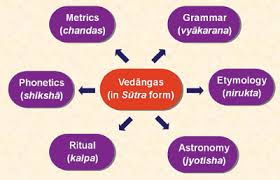
-
Siksha (Phonetics):
- Focus on oral preservation, phonetics and pronunciation.
- Ensures correct recitation of mantras.
-
Vyakarana (Grammar):
- Provides the grammatical structure to understand how the language functions.
- Ensures correct understanding of word forms and meanings.
-
Nirukta (Etymology):
- A compendium of words used in the Vedas.
- Provides the etymology (origins) and a book of synonyms, to ensure accurate meaning.
-
Chandas (Metrics):
- Deals with meters and syllable counts in mantras.
- Ensures no syllable or mantra is missed, and preserves the rhythm in recitation.
-
Kalpa (Ritual Manual):
- Like an operations manual, it provides rules and practices for performing Yajnas.
- Includes all details regarding different activities to be performed in yajnas.
-
Jyotisha (Astronomy and Time):
- Provides the methodology for timing events and performing activities at appropriate times.
IV. Importance of Vedangas
-
Appropriate Use: Knowledge of the six Vedangas is necessary to appropriately use what is prescribed in the Vedas.
-
Maximum Benefit: To benefit fully from the knowledge within the Vedas, knowledge of vedangas are required.
-
Best Use: Vedangas are necessary to extract the best results from the teachings of the Vedas.
V. Conclusion
- A good understanding of the six vedangas are necessary to interpret and gain maximum benefit from the Vedas