Basic Cost Terms and Concepts
R&D Project Decision Example
- Project cost: 100 m
- Estimated benefits (original): 160 m
- Amount already spent: 40 m (this year)
- Remaining spend: 60 m (next year)
- Revised estimated benefit: 90 m
Decision point:
- If you include the total cost (100 m), revenue (90 m) < cost ⇒ conclude “do not continue.”
- If you abandon now, loss = amount spent = 40 m.
- If you continue, total spend = 100 m, revenue = 90 m ⇒ loss = 10 m.
The 40 m already spent is a sunk cost (irrelevant for decision going forward).
What Is “Cost”?
Monetary measure of resources given up in acquiring goods or services.
3. Cost Classification
A. On the Basis of Time
| Term | Definition | Typical Use |
|---|---|---|
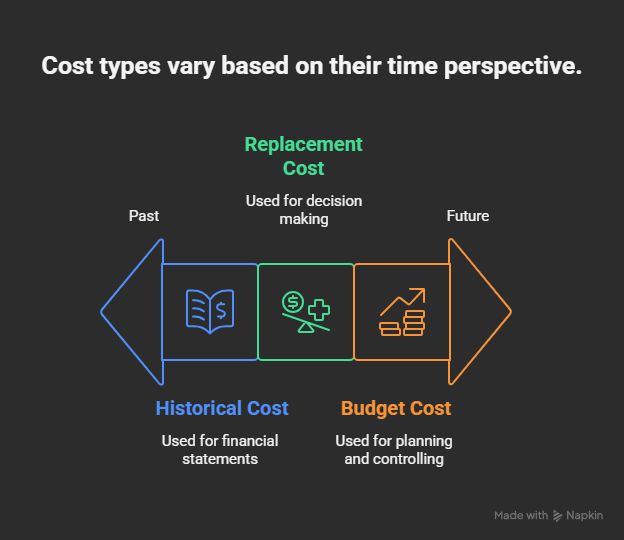
| Historical Cost (Past) | Cost actually incurred | Financial statements |
| Replacement Cost (Present) | Cost to replace resource now | Decision making, insurance computation |
| Budgeted Cost (Future) | Planned or standard cost | Planning and control |
B. On the Basis of Volume
-
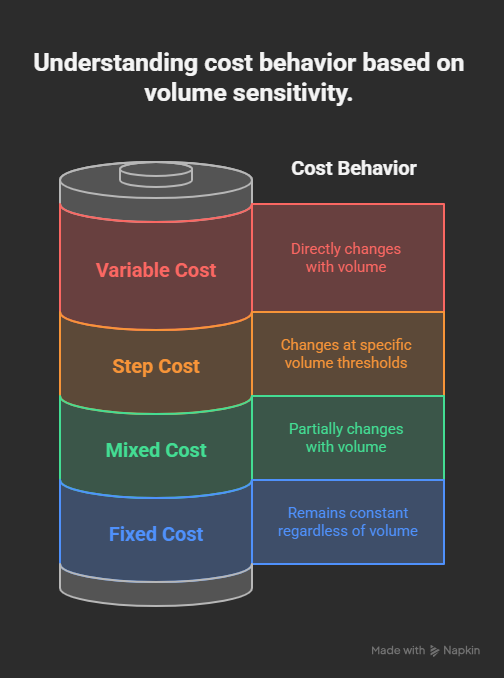
Variable Costs
- Change in total with volume.
- Examples: Material cost (manufacturing), Employee cost (software).
-
Fixed Costs
- Remain constant over relevant range.
- Example: Office rent.
-
Mixed Costs
- Have both fixed and variable elements.
- Example: Salary + commission for sales staff.
-
Step Costs
- Stay fixed over small ranges, then “step up” when capacity threshold exceeded.
- Example: Depreciation & maintenance on machines—if capacity > 1,000 units, need a second machine ⇒ costs double.
C. On the Basis of Financial-Statement Classification
-
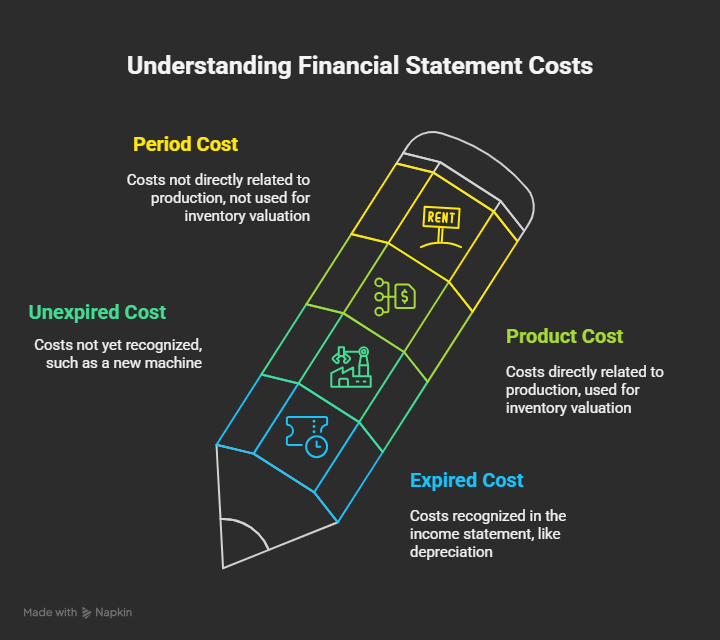
Unexpired (Deferred) Costs
- Capitalized on balance sheet initially.
- Example: Full machine cost on acquisition day.
-
Expired Costs
- Portions of unexpired cost allocated to current period.
- Example: Depreciation.
- Reported on the income statement.
-
Product (Inventoriable) Costs
- Directly related to manufacturing the product.
- Included in inventory valuation.
- Examples: Raw materials, direct labour, factory overhead.
-
Period (Non‑inventoriable) Costs
- Not tied to production volume; expensed immediately.
- Examples: Office rent, administrative salaries, sales‑dept. depreciation.
D. On the Basis of Decision‑Making Relevance
-
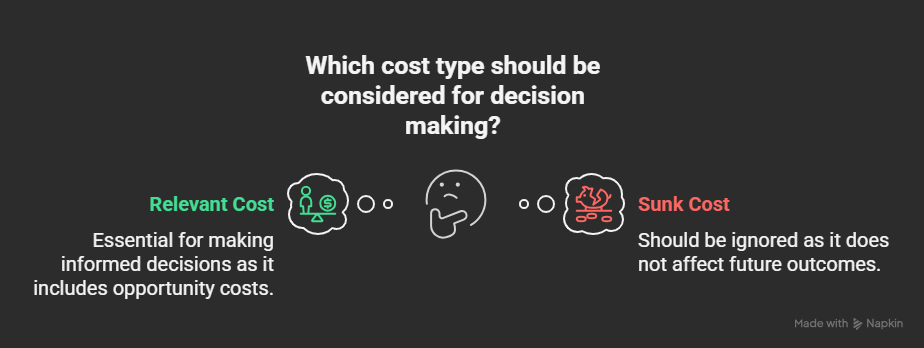
Relevant (Incremental / Opportunity) Costs
- Future costs or benefits that differ between alternatives.
- Example: Discount offered ⇒ explicit cost; extended credit period ⇒ foregone interest income or extra borrowing cost.
-
Irrelevant (Sunk) Costs
- Already incurred, cannot be recovered.
- Example: The 40 m spent on R&D so far.
4. Cost Flow & Cost Sheet Example (Room Air Conditioner)
| Item | Amount (₹ per unit) |
|---|---|
| Direct Material Cost | 10,815 |
| Direct Labour Cost | 1,646 |
| → Prime Cost (Material + Labour) | 12,461 |
| Manufacturing Overhead | 2,970 |
| → Cost of Goods Manufactured | 15,431 |
| Administrative Overhead | 2,028 |
| Selling & Distribution Overhead | 3,640 |
| → Total Cost of Sales (COGM + Admin + SDO) | 21,099 |
| Net Income per Unit | 3,801 |
| Average Sales Price | 24,900 |
| Profit Margin (3,801 ÷ 24,900 x 100) ≈ 15.27% | |
| Conversion Cost (Labour + Mfg OH) | 4,616 |
| Conversion Margin (3,801 ÷ 4,616 x 100) ≈ 82% |
Flowcharts