Banking Regulation in India
This document outlines a structured approach to understanding banking regulation in India, incorporating key topics, a timeline for learning, and suggested resources.
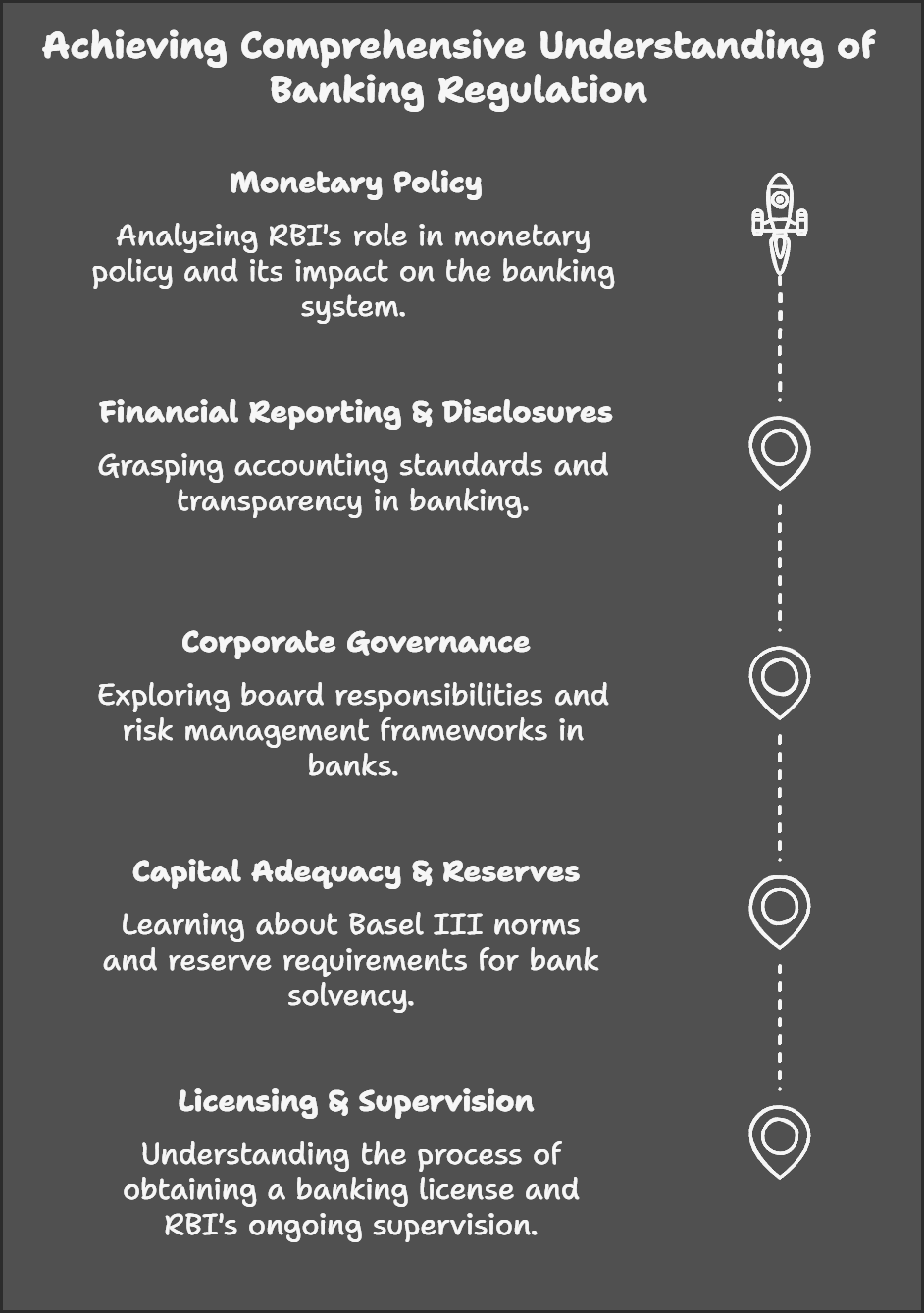
Key Topics
-
Licensing and Supervision:
- The process for obtaining a banking license from the Reserve Bank of India (RBI).
- Ongoing supervision by the RBI, including on-site inspections and off-site monitoring.
- Enforcement actions taken by the RBI in case of non-compliance.
-
Capital Adequacy and Reserve Requirements:
- Capital adequacy norms (Basel III framework) and their importance for bank solvency.
- Reserve requirements, including the Cash Reserve Ratio (CRR) and Statutory Liquidity Ratio (SLR).
- How these requirements influence a bank's lending capacity and liquidity.
-
Corporate Governance:
- Board structure and responsibilities in banks.
- Risk management framework and internal controls.
- Importance of ethical conduct and transparency in banking operations.
-
Financial Reporting and Disclosures:
- Accounting standards and reporting requirements for banks.
- Disclosure of key financial information to stakeholders.
- Ensuring transparency and accountability in financial reporting.
-
Monetary Policy:
- The role of the RBI in formulating and implementing monetary policy.
- Monetary policy tools (repo rate, reverse repo rate, OMO, etc.) and their impact on the banking system.
- How monetary policy influences interest rates, credit availability, and inflation.
Learning Timeline
- Week 1: Licensing and Supervision, Capital Adequacy and Reserve Requirements.
- Week 2: Corporate Governance, Financial Reporting and Disclosures.
- Week 3: Monetary Policy, Review and Consolidation.
Case Study Examples
- The Global Financial Crisis of 2008: Examine the regulatory failures that contributed to the crisis and the subsequent reforms.
- The Collapse of Lehman Brothers: Analyze the impact of inadequate risk management and capital adequacy on a major financial institution.
- The Satyam Scam: Study the corporate governance failures that led to the accounting scandal.
- The PMC Bank Crisis: Investigate the regulatory lapses and governance issues that resulted in the bank's collapse.
By following this structured approach and utilizing the suggested resources, you can gain a comprehensive understanding of banking regulation in India.